
As at 3 November 2026, the Department of Internal Affairs (DIA) has completed New Zealand’s first online-casino licence auction. Eleven entities secured rights to apply for 15 licences, but none has been approved to operate.
The Online Casino Gambling Act 2026 took effect on 1 May 2026. The new system will regulate online casinos serving people in Aotearoa New Zealand, while existing land-based casino venues remain under the Gambling Act 2003. The distinction matters to players checking whether a site is authorised, operators planning their next move, and community groups following changes to gambling revenue.
15 application rights, no licences yet
The DIA’s October auction attracted 32 bidders, ran for 10 rounds and ended on 12 October 2026 at NZ$15 million per licence. Its outcome was published on 13 October. The 11 successful entities now have access to the detailed application and assessment stage; they have not been cleared to operate as licensed online casinos. The final number of licences granted will depend on how applicants satisfy the regulator’s requirements.
Each online casino licence will be tied to one brand and may initially run for up to three years, with an option to renew for a further five years. An individual party cannot hold or exercise significant influence over more than three licences. The DIA intends to publish approved operators and their brands in an official public register once licences are granted. Its provider licensing update and the Government Electronic Tenders (GETS) auction outcome distinguish the completed auction from the outstanding licensing decisions.
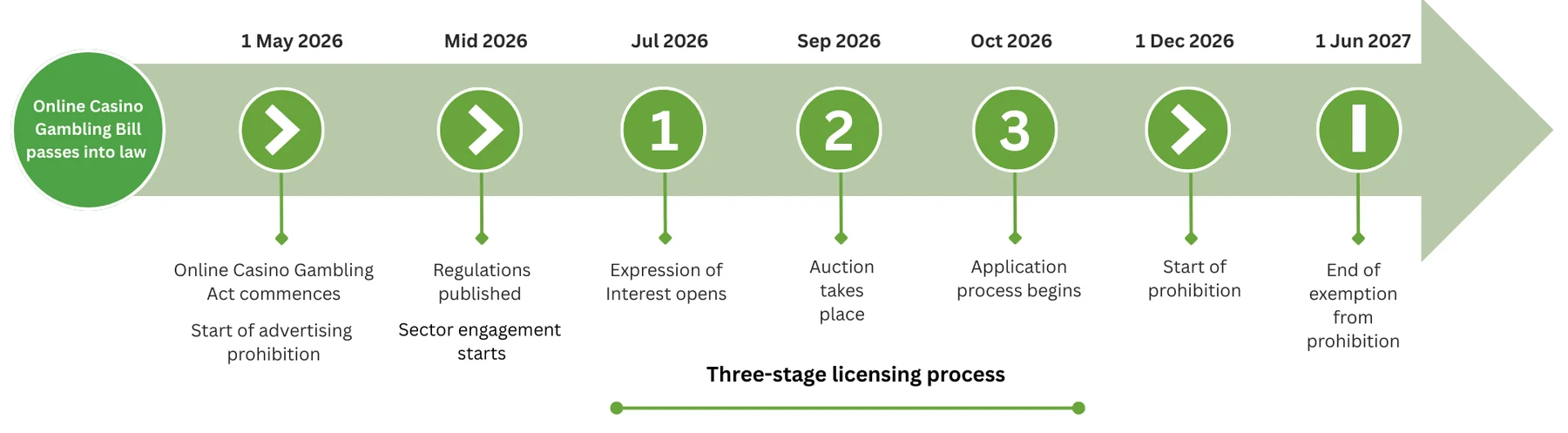
New Zealand casino licensing timeline
The 1 December deadline and 1 June outer limit do different jobs. Under Schedule 1 of the Act, a provider already serving New Zealand at commencement that applies before 1 December can use the transitional exemption only until the day after its licensing decision or 1 June 2027, whichever arrives first. A provider without that qualifying application loses the transitional exemption on 1 December 2026.

Which companies won the right to apply?
The official auction result identifies legal entities rather than a complete list of consumer-facing casino brands. Corporate names, familiar gambling brands and licence status are separate pieces of information: a successful bid does not establish that every website associated with a group will receive approval.
SkyCity Entertainment Group separately reported to NZX that its two entities had won the right to apply for two licences, each carrying a NZ$15 million fee excluding GST. The appearance of SkyCity, Stake New Zealand or TAB New Zealand on the auction list is evidence of progress through a competitive process, not confirmation that an online casino brand has obtained a New Zealand licence.
How the online casino licence application works
Stage 1: Expression of interest
Providers submitted an expression of interest (EOI) through GETS. An accepted EOI opened the door to the auction; it was neither an operating permission nor a licence application. The original GETS EOI notice set out the first-stage requirements.
Stage 2: Competitive auction
Qualified participants bid for a limited number of application rights. The NZ$15 million outcome reflects the auction price per licence, not a guarantee of regulatory approval. The cap of 15 licences restricts the number of brands that can enter the eventual licensed market; it does not authorise every brand operated by a successful bidder.
Stage 3: Full application and suitability assessment
Successful bidders must pay the auction amount and submit a detailed application within 20 working days of notification, unless the Secretary permits more time. Applications require a business plan, financial projections, a New Zealand address for service, platform and brand details, and strategies covering advertising, consumer protection, harm prevention and compliance. The DIA assesses suitability and the applicant’s ability to meet its legal duties; community contributions and a New Zealand presence are among the matters it can consider. Licences carry conditions and can be suspended or cancelled for non-compliance. Section 18 and section 19 set out the application material and approval criteria.
How to tell whether an online casino is genuinely licensed
- Once the regulated market begins, the most reliable test will be the DIA public register of licensed operators and brands. The register is meant to identify the legal operator and the brand covered by its licence. Licensed platforms will also have to display a distinctive registration icon and play a registration audio mark. A logo shown on a casino website cannot replace checking the corresponding entry in the regulator’s register.
- The difference between an overseas gambling licence and a New Zealand licence is equally important. A site licensed in Malta, Curaçao or another jurisdiction is not automatically authorised under New Zealand’s new framework. Its right to serve New Zealand customers will depend on the local Act, applicable transition provisions and, after approval, the exact scope of its DIA licence.
- A credible licence check matches three things: the legal entity, the authorised consumer brand and the licence’s current status. A company name in the October 2026 auction results satisfies only the first part of that check. A brand that changes ownership or name should still be traceable through the DIA’s official record.
Online licences and physical casino venues
An online casino application right does not create a land-based venue licence or permit a new casino building. The two systems are separate; see the gambling law guide for the physical-venue rules.
Questions that still matter before the 2027 launch
Have any of the auction winners already been approved?
Not by virtue of the October auction. The published result records rights to apply; actual licences require completed applications and successful assessments. The DIA expects to begin issuing licences from early 2027.
Can an offshore casino keep accepting New Zealand players throughout 2027?
Not simply because it previously served the market. An eligible provider with a qualifying application can rely on the statutory transition only until the earlier of its licensing decision and 1 June 2027. A refusal ends that route, and an offshore licence by itself does not substitute for New Zealand authorisation.
Does a licence cover every brand owned by a company?
No. The new framework links each licence to a single brand, although that brand may be offered across multiple platforms. The regulator will identify approved brands in the public register.
What is the clearest sign that the market has fully changed?
The decisive change will be the appearance of actual DIA licensing decisions and a public register naming approved operators and brands, alongside the end of the transitional operating window. Auction results, corporate announcements and overseas licence badges answer different questions.