
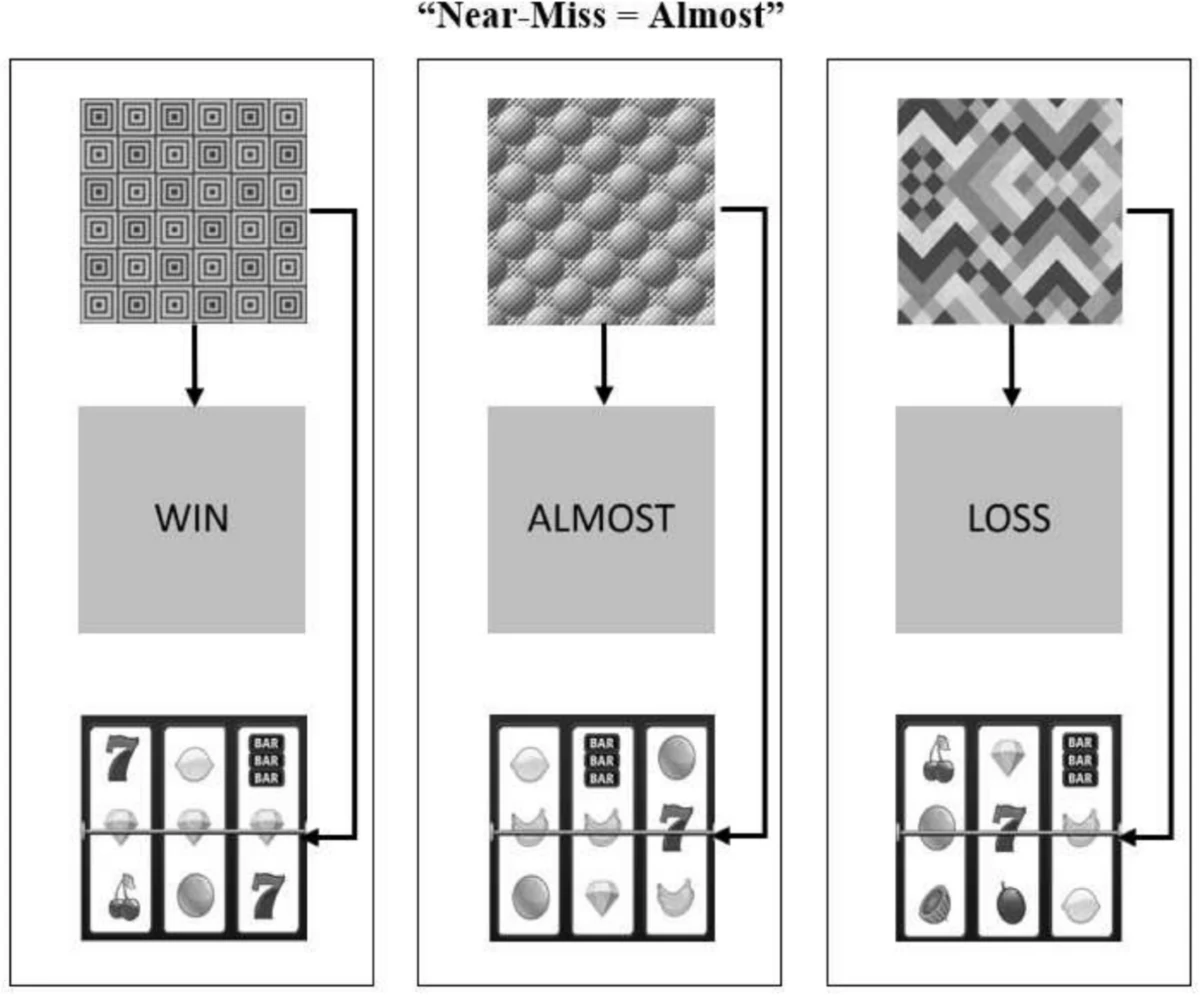
Two matching jackpot symbols appear on a pokie screen. The third stops just above the payline. Nothing is won, yet the result can feel more exciting than an ordinary loss. The urge to try again arrives before the disappointment has settled.
That gap between what a casino game pays and what a player feels is central to the psychology of casino games. Uncertain rewards, visual feedback, personal choices and the pace of play can make chance feel meaningful. A dramatic near miss offers no mathematical progress towards a jackpot, while a small payout can still leave the player poorer than before the spin.
Casino games do not need to change the odds to influence how those odds are experienced. Their strongest effects often occur between outcomes: while a reel slows, a card is revealed, a roulette ball circles the wheel or a balance flashes on the screen.
Why anticipation can feel as powerful as winning
Most games have an outcome. Casino games add a stake, an uncertain payoff and repeated opportunities to make another decision. That combination recruits the brain's systems for attention, motivation, learning and reward. The suspense begins when a bet is placed, not when a prize arrives.
Dopamine is involved in learning about rewards and in the motivation to pursue them. It is not simply a chemical measure of pleasure, and a colourful animation does not automatically produce a predictable dopamine surge. Anticipation, uncertainty and the difference between an expected and an actual result all shape reward-related signalling. A win that arrives unexpectedly can feel particularly salient; a loss that almost resembles a win can capture attention too. The distinction between wanting and liking helps explain why the motivation to continue may outlast enjoyment of the game itself.
Psychologists describe part of this learning process as reward prediction error: the discrepancy between what was expected and what happened. An unexpectedly favourable result can strengthen the association between an action and a reward. Repeating a casino game creates many chances to update that association, even though the outcome of a chance-based game cannot be improved through enthusiasm or persistence.
Excitement also involves arousal. A racing heart, focused attention and rising tension can be experienced as enjoyment by one person and stress by another. The same game does not affect every player in the same way. Mood, previous experiences, financial circumstances and the speed of play all matter.

How game design changes the experience of chance
Game design influences what players notice and how quickly they respond. A casino floor uses sound, lighting, layout and social atmosphere; an online casino uses interface design, animation, menus, notifications and timing. None of these features has to alter the underlying probability to affect attention.
Sound, colour and animation
Win jingles, flashing paylines, spinning reels, moving counters and bonus-trigger effects attach strong sensory feedback to selected outcomes. A small return may receive more noticeable feedback than a larger losing stake. Familiar game themes, characters and music add recognition and emotional associations. The visual language of success can be louder than the financial reality.
Speed and friction
Rapid rounds mean more decisions can fit into a short period. Quick-spin controls, streamlined deposits and other low-friction interface features can reduce the pause between intending to gamble and doing so, where those features are available. A faster game does not necessarily alter the house edge per bet; it can increase the amount staked over an hour if the player continues at the same stake.
Progress, control and social cues
Bonus meters, free-spin counters, jackpot displays and level-like features can suggest advancement. A visible progress bar may represent a genuine feature rule, but it does not automatically mean the base game is getting closer to a win. Stop buttons and reel-selection features can create a sense of agency without changing a random result when the rules do not give the player genuine control over that result.
Leaderboards, live-dealer chat, tournaments, loyalty points and stories about large winners introduce comparison and social proof. Their psychological appeal differs from the mathematics of the wager. Fear of missing out can add urgency without adding a statistical advantage. A promotion or an unusually large displayed win says little about a typical player's long-run return.
The cognitive biases that make randomness look predictable
People are skilled at detecting patterns and finding causes. Those habits are useful in daily life but can mislead us in games built around uncertain or outcomes unaffected by earlier results. Gambling-related cognitive distortions affect how a player interprets recent results, personal choices and memories of past wins.
Superstitious beliefs, lucky numbers, the belief that a machine is “hot” or “cold”, and selective memory can reinforce these shortcuts. A player may build a story around a random sequence, then treat the story as a strategy. Such beliefs can feel persuasive without producing a measurable advantage.
Not every form of control is illusory. Choosing a roulette bet changes the range of outcomes that pay, and blackjack decisions can change the expected return. The mistake is attributing control to a feature that has no causal connection to the result.
Different casino games create different psychological pressures
Casino games share uncertainty, but their pace, feedback and genuine decision-making differ. Treating pokies, roulette, blackjack and poker as psychologically identical hides useful distinctions.
Blackjack deserves particular care: dealing cards without replacement changes the composition of the remaining deck, so its probabilities are not identical to roulette spin outcomes. Poker played against other people has a substantial skill component. Neither exception turns a random slot machine into a skill game.
Why a losing session can become difficult to stop
Chasing losses gives the next bet a job: undo the previous one. That can lead to higher stakes, longer sessions or risks a player would otherwise reject. Fast, repetitive games can also narrow attention and temporarily displace boredom or worry; this is not universal and is not, by itself, a diagnosis.
Warning signs include repeatedly spending beyond a limit, hiding losses, using essential money, borrowing, neglecting obligations or feeling distressed when unable to stop. Harm can affect relationships, work and whānau as well as finances.
Time and spending limits, activity statements, breaks and self-exclusion can create boundaries, but cannot make a negative-expectation game profitable. If limits repeatedly fail, stepping away and seeking specialist support is safer than trying another betting system.
How to recognise the difference between a cue and an advantage
A useful question is not whether a game feels exciting. It is whether a specific sensation contains information that changes the probability or expected value of the next decision.
- “I was one symbol away.” A near miss describes a losing outcome. It does not establish progress towards a jackpot.
- “The machine paid me three times.” Check each payout against its total stake. Three celebratory events may still represent three net losses.
- “Red has to come next.” A fair roulette wheel has no memory. Earlier colours do not alter the next spin's pocket probabilities.
- “The bonus meter is almost full.” Read the feature rules. A visible display may track a real mechanic, but it is not proof that ordinary wins are becoming more likely.
- “I know the right moment to stop the reels.” Check whether timing actually changes the outcome. A cosmetic control is not a skill advantage.
- “I only deposited NZ$40.” Compare deposits and withdrawals, not just turnover or the number of wins.
- “One bigger bet will recover the loss.” An earlier loss changes the player's financial position, not the expected return of the next wager.
These checks separate perceived control from actual control. They also reveal why a game can be entertaining and mathematically unfavourable at the same time. What appears on the screen is feedback about a past result; what matters for the next decision is the rule governing the next result.