
A roulette wheel settles; a slot screen lights up with multipliers. Thirty seconds later, the result is on Instagram Reels, TikTok or YouTube Shorts, surrounded by excited comments. The number looks enormous. The clip rarely shows what the player spent getting there, what happened after the win, or whether any money left the casino account.
For New Zealand viewers, a win clip is not proof of a profitable session. A documented jackpot, a streamer's balance and a paid promotional message deserve different treatment. Online-casino advertising is restricted while the 2026 - 27 licensing system is introduced.
Four winning stories, four different kinds of evidence
Tim Naki: a Kiwi blackjack run built for Instagram
Tim Myers, better known as Tim Naki, grew up in Taranaki and drew attention in 2024 while living in Canada. His Instagram blackjack challenge used a striking rule: a daily bet of ten cents per follower. The first stake was $1,500; as the audience grew, the wagers reached six figures. People were following the countdown as much as the cards.
Accounts at the time put Myers at about $1 million in cumulative profit on day 83. By the end of the ninety-day challenge, later losses had reduced that reported profit to roughly half. The day-by-day account published by Casino.org records both the rise and the setback. These were figures reported during a public challenge, not verified against bank statements.
The day-83 headline and the day-90 result tell noticeably different stories. Blackjack involves decisions, but even an extraordinary run of winning hands does not erase the house edge. A follower count is an entertaining way to set a stake, not a method for beating the casino.
Jon Heywood: a jackpot with a formal record
Jon Heywood's payout has a more formal paper trail. In October 2015, he won €17,879,645 playing Mega Moolah, developed by Microgaming, through Betway. Guinness World Records records the payout, along with the game, operator and date. That's far more to check than a screenshot with a large balance.
The record belongs to a particular category and date. It cannot be carried forward as proof that a more recent clip broke the same record. Heywood's win also says nothing about the probability of another player hitting the jackpot.
WowPot!: a supplier-announced €38.46 million payout
On 20 December 2023, a player on Wheel of Wishes hit the WowPot! progressive jackpot. Games Global announced a €38,461,200.95 euro-equivalent payout the following January. The supplier named Alchemy Gaming as the developer and said the prize exceeded an earlier €19.4 million payout on Mega Moolah. Its original Games Global announcement is the source of those figures.
The announcement did not identify the operator or the winner. It documents what the supplier reported about the jackpot, not the recipient's personal finances. A linked progressive prize can grow to an extraordinary size without telling the average slot player much about likely returns.
Roshtein, streamed wins and verifiable records
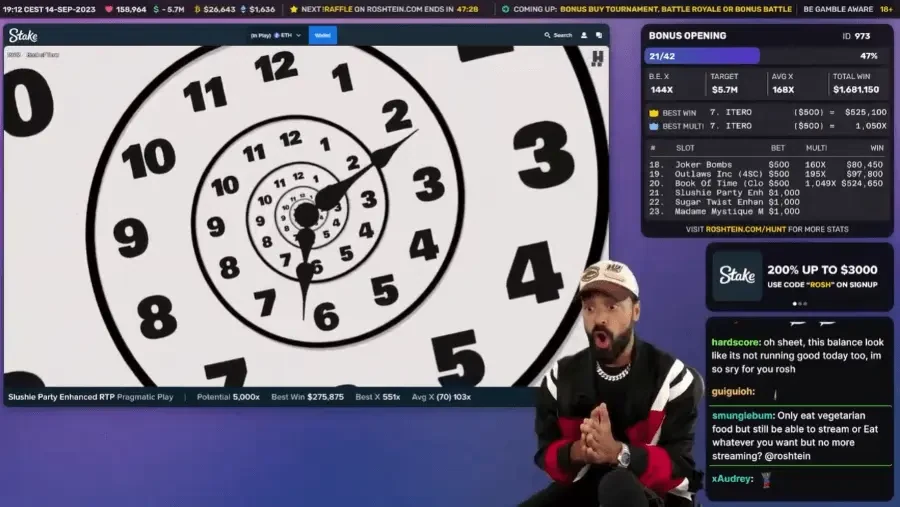
On Kick, slot streamer Roshtein turns high-stakes sessions into widely shared clips. His own website described a roughly $28.5 million win on Drac’s Stacks from Massive Studios in June 2024. The figure came from his own publicity. It should not be treated as a Guinness-adjudicated record or a net-profit figure verified by an external auditor.
The source of a win claim matters more than its place on a leaderboard. An adjudicated record and a streamer's own account do not answer the same question.

A giant payout is not the same as a giant profit
The words win, payout, profit and balance are easily blurred in casino clips. Consider a $50,000 result that includes the original stake, or a $50,000 balance after $70,000 in deposits. Promotional credit, funded accounts and private commercial arrangements can complicate the picture further. None of that justifies alleging that a particular streamer uses fake funds without evidence. It does justify asking who actually bore the risk.
Currency adds another trap. A headline saying “$1 million” might mean USD, AUD or NZD. When a foreign prize is converted to New Zealand dollars, the exchange rate and conversion date belong next to the sum. Otherwise two different amounts may circulate as though they were the same win.
What New Zealand’s casino rules mean in November 2026
The Online Casino Gambling Act took effect on 1 May 2026; the DIA expects the licensed market to operate in 2027. During transition, online-casino advertising to people in NZ remains prohibited. The DIA can seek takedowns and penalties of up to NZ$5 million; future rules also restrict sponsorships, personal endorsements and affiliate arrangements.
A report about a jackpot is not automatically advertising. A paid endorsement, referral code or operator-controlled invitation raises different questions. Check who made the message and whether it is promotional; the ASA also expects gambling ads to be truthful and not misleading about winning chances.
Use the DIA public register when licensing decisions begin. An offshore licence badge or a streamer's reassurance is not a New Zealand licence.
What a casino-win clip leaves unverified
- Identify the original event. Find the unedited stream or the first report, the date, the game and the currency. Reposts often remove those details.
- Classify the evidence. A Guinness record, a supplier release, an operator statement and a streamer's own caption carry different levels of outside support.
- Separate payout from net result. Ask what was staked, how much was lost earlier and whether the money was actually withdrawn. A single screen cannot answer all three.
- Read the commercial signals. Branded overlays, promo codes, sponsor disclosures and repeated referrals identify incentives beyond entertainment.
- Check the game's mechanics. Jackpot type, RTP, volatility, side bets and bonus-buy costs explain why two apparent “wins” are not comparable.
- Apply the New Zealand context. An offshore licence, a platform's streaming rules and a New Zealand licence are three different things. The DIA's current guidance is the reference point for local regulatory status.
Even an original stream cannot reveal private deposits, withdrawals or sponsorship terms that were never shown. It can establish which game appeared, what was claimed and how the claim was presented. Anything beyond that needs more evidence.
The risk that disappears from the replay
A run of spectacular clips can make unusual wins feel routine. Someone anxious about money may begin to see the jackpot as a way out; someone who has lost may feel pushed to recover it. Neither response alters the odds or the money already spent.
Gambling harm does not stop with the account holder. The New Zealand Ministry of Health estimates that around one in five people will experience harm in their lifetime from their own gambling or someone else's. Debt, secrecy and pressure on whānau seldom appear in a fifteen-second casino reaction.
Free, confidential help is available through PGF Services. New Zealand's Gambling Helpline is on 0800 654 655, or text 8006. There is a difference between enjoying a casino clip and seeing gambling as a way to pay the bills, especially when losses become difficult to stop.
What the biggest viral wins actually tell us
After the cheering ends, the relevant numbers are less photogenic: total stakes, deposits, withdrawals and any arrangement that funded the play. The four famous cases cannot supply those figures for an ordinary New Zealand viewer.
A jackpot screen cannot show the deposits made before the camera rolled, the losses that followed or whether the money was withdrawn. Those missing entries matter more than the size of the number flashing on screen.